
Basal joint arthritis does not affect everyone in the same way.
Although it can occur in anyone who regularly uses the joint at the base of their thumb, some are more at risk than others.
Understanding the predisposing factors helps to better anticipate this condition, its impact, and the strategies to adopt on a daily basis.

A distinct predominance among women
A distinct predominance among women
Women represent the vast majority of people with basal joint arthritis.
This predominance is explained by a combination of hormonal, biomechanical and genetic factors. Thumb pain is often more frequent or more severe from menopause onwards. This link between menopause and basal joint arthritis is now well documented, in connection with hormonal variations that influence joint ageing.
In addition, there are other vulnerability factors, such as a genetic predisposition, or anomalies in the shape of the trapezium bone, mentioned on the ‘Risk factors promoting basal joint arthritis’ page.
An age-related condition… but not just that
Basal joint arthritis mostly occurs after the age of 50, reaching a peak around 60 to 70 years of age. Since cartilage wear is a natural process, it makes sense that age is an important factor. But the condition can also affect younger people, especially in the case of repetitive actions or significant mechanical constraints.
We are then talking about basal joint arthritis in young adults, a rarer but very real form. These early cases are sometimes associated with past trauma, joint deformities or hypermobility. In all cases, recognising the first symptoms allows for earlier treatment.

Manual jobs and risky activities
Manual jobs and risky activities
Some professions are more prone to basal joint arthritis.
This is particularly the case for hairdressers, dressmakers, carers, musicians, craftspeople and beauticians. Not everyone will develop the condition, but repetitive actions, pincer movements and loads carried by the thumb promote joint wear.
Leisure activities can also have an impact such as gardening, DIY and sports involving the hands. It then becomes essential to adapt your actions.
The ‘Living with basal joint arthritis’ section contains practical advice on how to continue your activities without experiencing more pain.
Sometimes both hands are affected
Although basal joint arthritis often begins in a single thumb, it can progress to both hands.
In this case, both thumbs are affected, sometimes within a few months or years of each other. This bilateral basal joint arthritis complicates daily actions, as it further reduces the strength and mobility of the hand.
It is more common in older women and in people who use both hands symmetrically, in their work or in their leisure activities.
Symptoms that are sometimes misleading
Thumb pain is not always due to basal joint arthritis.
From tendonitis and cysts to arthritis of another joint, it is not always easy to hit the nail on the head. Some people confuse the symptoms, especially as basal joint arthritis progresses slowly.
This is why it is useful to understand the differences between thumb arthritis and basal joint arthritis, and to be familiar with the anatomy of the thumb in order to correctly locate the joint in question.
The pain is often localised at the base of the thumb, but can also radiate to the wrist or worsen during specific actions. These specific joint pains may appear intermittently before becoming persistent.
When to consult a hand specialist?
La prise en charge psychologique de la douleur ne remplace pas les traitements physiques ou médicaux.
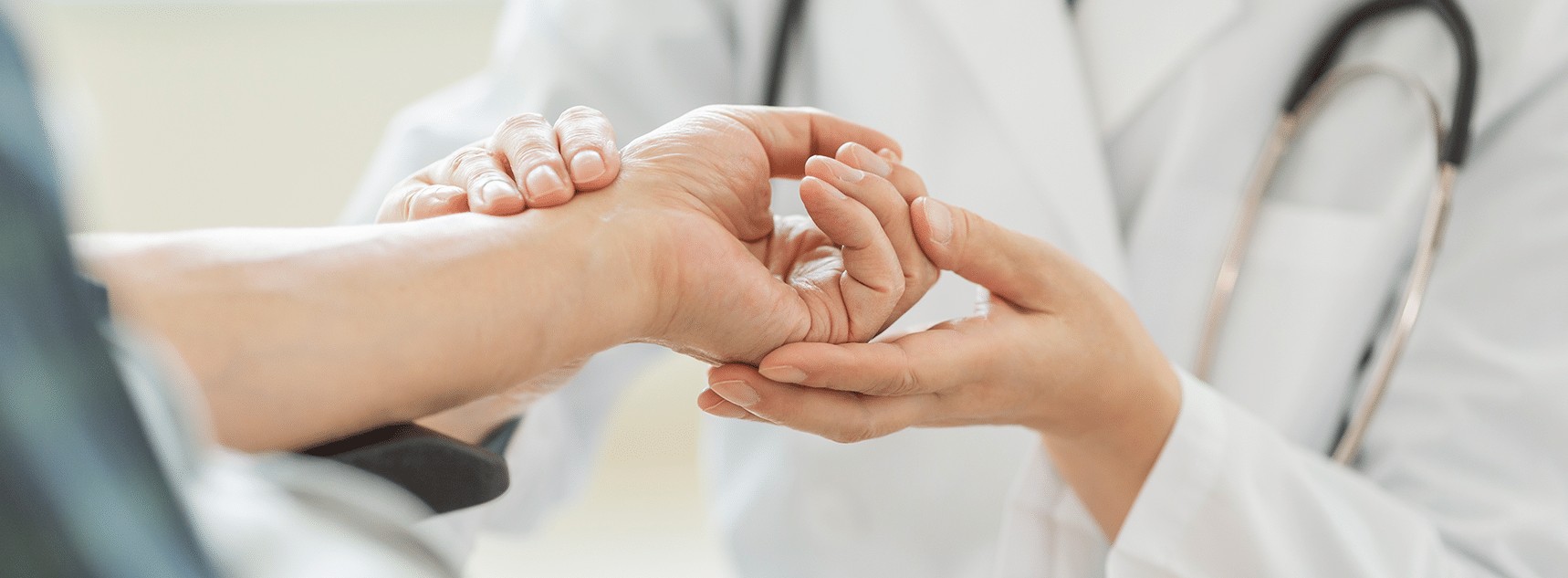
The diagnosis of basal joint arthritis is based on an initial clinical examination and then on a single X-ray, which is often sufficient. If the condition is confirmed, several approaches may be proposed, as described on the ‘Treatments and care’ page.
In some cases, especially in the absence of improvement with medical or orthopaedic treatments, a consultation with a hand specialist may be considered.
They will be able to assess the relevance of surgery, which is currently the only solution capable of permanently correcting joint wear.


