
Before you exert yourself physically, you are more than likely to think about warming up first. We often forget, though, that our hands also need some preparation.
The joint at the base of the thumb (known as the carpometacarpal joint) is often put under considerable strain or used to a significant extent and is therefore vulnerable.
If you are suffering from thumb osteoarthritis, or if you just want to keep the joint supple and flexible, there are some simple exercises available that can help reduce mechanical stress and prevent wear.
These exercises form part of a preventative approach, to be adopted in conjunction with other recommendations that can be found by clicking on ‘Prevention and education’.

Why should you warm up your thumb joints?
Thumb osteoarthritis is caused by progressive wear of the cartilage at the base of the thumb.
This area is called on when performing many of our day-to-day movements: grasping, pinching, carrying, turning, and so on. If you are constantly repeating these movements without preparation, it can accelerate the onset of pain or stiffness.
Warming up your joints regularly helps with the following:
Getting into this daily habit is really important if you have to perform repetitive actions at work or at home.
It complements other protective measures, which you can read about under ‘Adapting your day-to-day life to thumb osteoarthritis’.
Remember
A few basic principles before you get started:
5 minutes a day is enough to maintain good joint mobility.
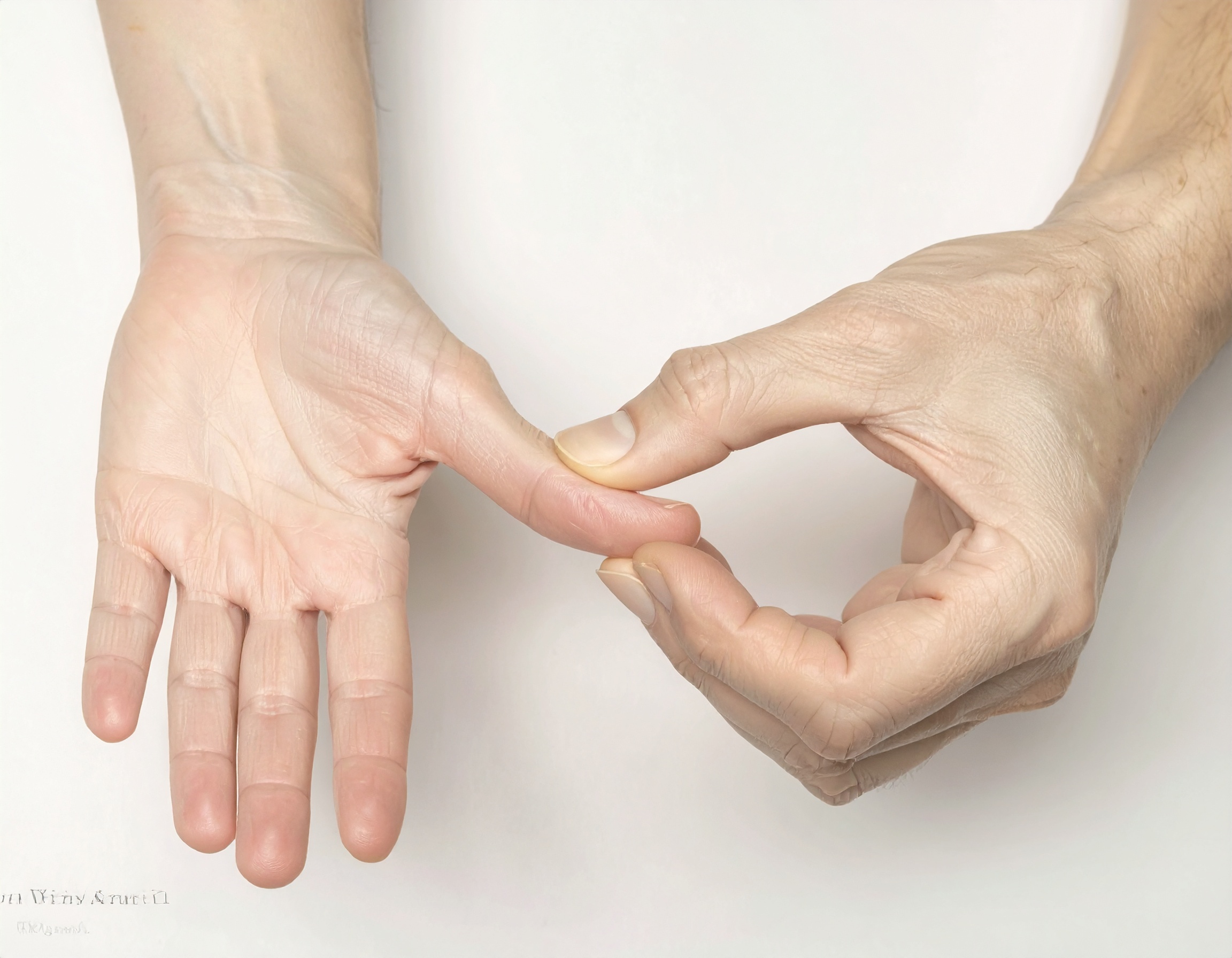
4 targeted warm-up exercises
You do not need any equipment for these exercises. You can do them at any time of the day, at home or at work.
1. Thumb circles
With your hand flat and your fingers slightly apart,
draw a circle with your thumb, first in one direction, then in the other.
2. Gentle pressing
Touch the pad of each finger with the pad of your thumb.
Press lightly on each, then release.
3. Fan
Spread all your fingers as wide as you can, stretching your hand fully, then slowly close it.
4. Passive stretching
Gently pull your thumb outwards using your other hand.
Hold the position for 5 to 10 seconds.
When should you perform these exercises?
By making these exercises part of your daily routine you will:
These exercises are also useful in conjunction with certain aids, such as specially adapted tools.
To find out more please go to ‘Grip help: tools for patients’.
Adopting protective habits
Warm-up exercises are not intended as a replacement for medical care, but they should form part of an overall approach to looking after your joints.
They can be combined with other simple habits:

