

Basal joint arthritis is a form of arthritis at the base of the thumb.
Identifying the signs, understanding the causes, anticipating the progression.
On the Basal joint arthritis page, we explain how this degenerative condition can progressively hamper everyday movements: turning a key, writing, carrying a bag or even just opening a jar.
To cope better with the condition and choose the right solutions at the right time, it is essential to understand what is happening to the joint, why it is happening and how it will progress. This page provides a link between the first signs, the possible causes, the mechanisms involved and the steps involved in diagnosis.
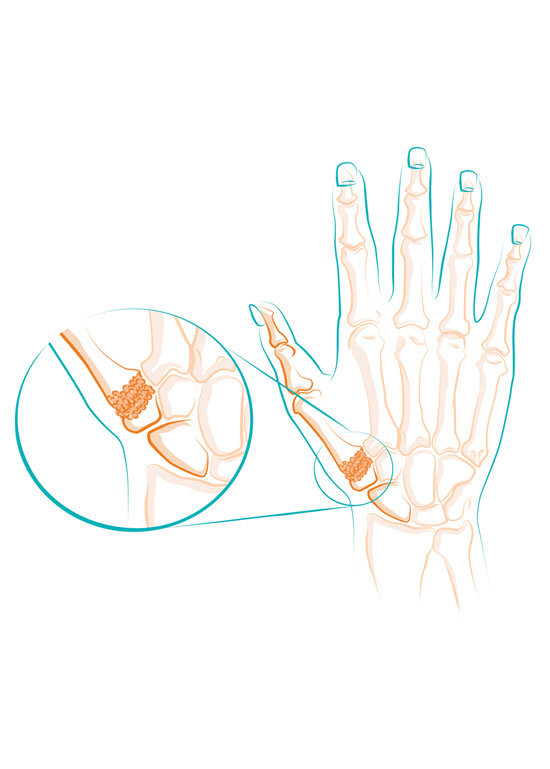
Arthritis specific to the base of the thumb
Basal joint arthritis is the wearing away of cartilage at the trapeziometacarpal joint, located between the first metacarpal and a small bone in the wrist called the trapezium.
This area is used extensively in everyday movements: it enables the thumb to perform a wide variety of movements (bending and extending, moving away from and towards the hand), which are essential for gripping. The opposition of the thumb, in particular, makes it possible to form a pincer with the other fingers and handle objects with precision.
When the cartilage deteriorates, the bone surfaces come into contact, causing issues like pain, stiffness and inflammation and sometimes progressive deformation of the thumb.
The first signs: when should you be worried?
The condition often creeps in. Some signs may go unnoticed or may be attributed to simple joint fatigue:
Over time, these pains become more frequent, or even constant. They often appear at the end of the day or when resuming a specific action.


Thumb arthritis or basal joint arthritis: are they the same thing?
Yes, these two terms refer to the same condition.
The term ‘basal joint arthritis’ is simply more precise: it refers specifically to arthritis of the trapeziometacarpal joint at the base of the thumb.
The term ‘thumb arthritis’ is more common in everyday language.
What are the risk factors?
Basal joint arthritis mainly affects women, particularly after the menopause. But it can also affect younger people.
Several factors are likely to increase the risk:
It sometimes affects both hands, either simultaneously or separately: this is known as bilateral basal joint arthritis.



A disease that progresses slowly… but surely
Basal joint arthritis progresses in stages.
Initially, it causes moderate discomfort, but over time the pain may intensify, movements become more difficult and the thumb may become deformed.
The stages of progression are not always visible from the outside.
But they do allow us to adapt the treatment according to the degree of damage.


Fluctuating pain not always easy to locate
The pain caused by basal joint arthritis is sometimes misidentified by patients: it may radiate to the wrist, occur only during certain movements or be present even when at rest.
It can also appear during flare-ups, making everyday life unpredictable.

