
When basal joint arthritis reaches an advanced stage, daily discomfort may become such that surgery is considered.
Among the most common solutions, two techniques stand out: trapeziectomy and fitting a trapeziometacarpal or TMC prosthesis.
Both have the same aim: to relieve pain, restore mobility and preserve thumb function. However, they differ in principle, post-operative course and indications.
This page is a continuation of the ‘Treatment and care’ section, linked to the ‘Basal joint arthritis’ page.

TMC prosthesis: preserving movement and strength
The trapeziometacarpal prosthesis replaces the worn joint between the trapezium and the first metacarpal with an implant, with the aim of restoring near-natural movements.
This technique is particularly suitable for patients who are still active and whose activities require good mobility and some grip strength.
Pros:
Good to know :
For more details: TMC prosthesis: how it works and results
Trapeziectomy: a tried-and-tested solution
A trapeziectomy involves removing the trapezium, the worn bone responsible for the pain.
It may be complemented by tendon interposition or ligamentoplasty to stabilise the joint.
This is a well-known surgical technique that is still widely used, particularly when a prosthesis is not an option.
Pros:
Possible limitations:
This solution is often proposed for people with less demanding functional requirements, or when the condition of the joint makes a prosthesis unsuitable.
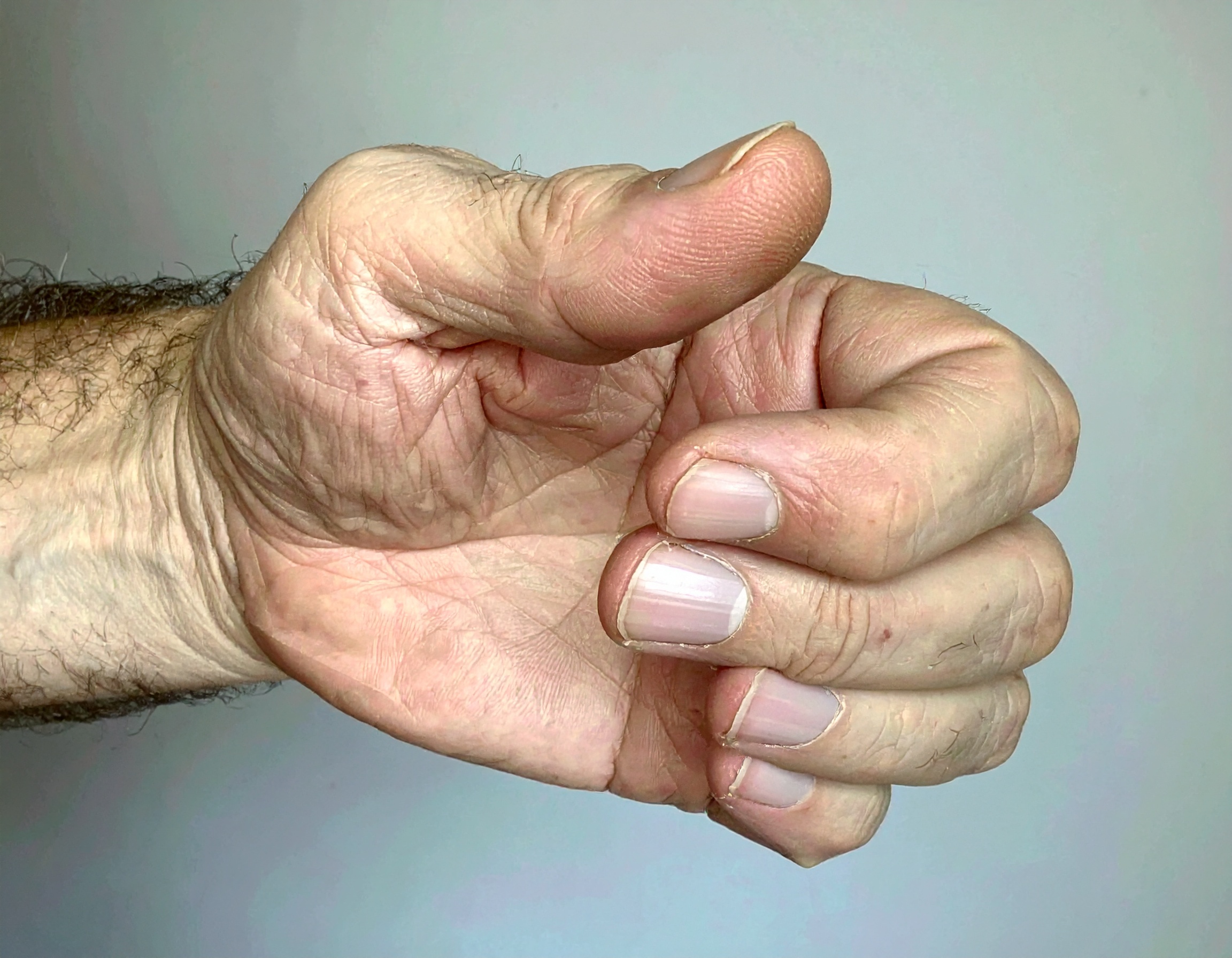
A choice guided by the profile of each patient
There is no single rule for choosing between a trapeziectomy and prosthesis.
It is determined by several factors assessed during the surgical consultation:
When an operation becomes necessary, the ‘Basal joint arthritis surgery: when should you consult a specialist?’ page can help you identify the right time to review your situation with a specialist.
Two techniques, one goal: regaining comfortable use of the hand
Trapeziectomy or prosthesis: the key is to adapt the technique to the patient, not the other way round. The hand surgeon plays a key role in this decision, explaining:
In any case, the operation is part of a progressive care pathway, which begins well in advance with non-surgical solutions:
braces and splints, injections, physiotherapy and home exercises, etc.
To understand post-op follow-up:


