

Thumb osteoarthritis does not usually occur suddenly.
Thumb osteoarthritis, also known as basal joint arthritis, is a progressive condition that often creeps up on you quietly before it becomes really limiting. As explained on the main page on thumb osteoarthritis, by acting early you can limit its effects or slow its development. Prevention and education are therefore essential for maintaining thumb mobility and good quality of life.
Education, identification and support are the three pillars of a proactive approach to health, whether you are at risk or newly diagnosed.
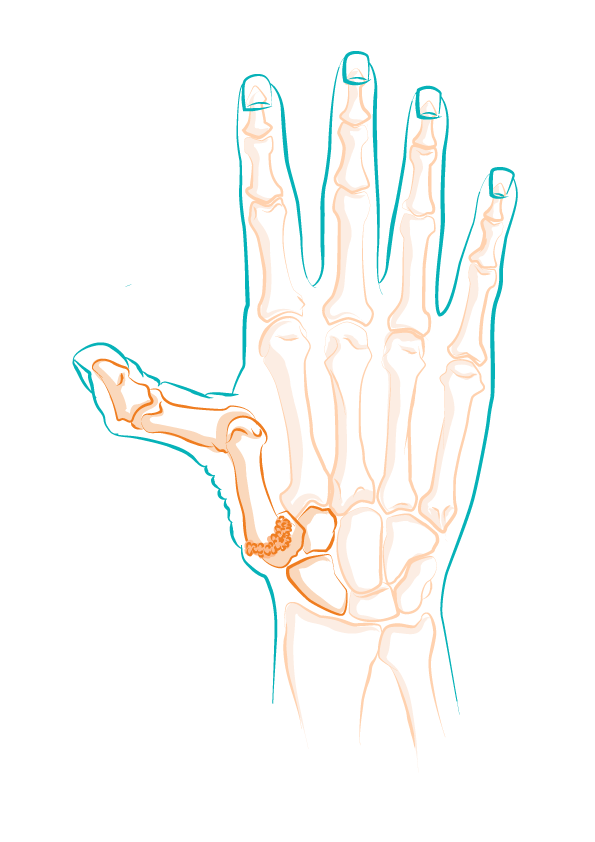
The more you know, the easier it is to prevent
Many people have never heard of thumb osteoarthritis until the pain has already started.
There are certain warning signs though: discomfort with pinching movements, loss of strength, feeling of stiffness, etc. If you recognise those signs early, you can react quickly to prevent or slow progression.
It is vital to start adapting your movements from the very first stages.
Take occupational risks into account
Certain types of work put particular stress on the joint at the base of the thumb :
manual professions, jobs involving repetitive movements, vibrating tools (hairdressing, sewing and dressmaking, construction-work, health-work, etc.).
You can reduce mechanical stress by adapting the movements you make and varying the positions in which you make them, and also by using ergonomic equipment.


Keep your joints supple and flexible by warming up
Preparing your hands before prolonged activity is a good idea, as with anything you do that requires use of your muscles or joints.
A few simple flexibility exercises can help maintain mobility and limit microtrauma. Practical examples can be found under ‘Warm-up exercises to avoid joint wear’.
Ergonomics and adjusting the way you perform tasks
How we organise our workplace and the way we perform day-to-day tasks have a direct effect on the health of our joints.
There are simple solutions available, from wide handles and non-slip tools to keeping your wrist in a neutral position. There are plenty of methods you can incorporate into your life to protect your thumb joints.


Post-diagnosis insights
There are still things you can do to help after diagnosis.
It is important to understand how the condition works, what to change and mistakes to avoid – that will allow you to slow down progression of the condition and can help to ensure that treatment remains more conservative.
Therapeutic education plays a central role here.
Encouraging early detection and diagnosis
Thumb osteoarthritis is sometimes taken too lightly in both general and occupational medicine.
Early detection and diagnosis mean that measures can be taken before the pain becomes chronic.
Ensuring that doctors and healthcare professionals are properly informed, providing simple self-assessment tools and encouraging medical consultation at the first signs of the condition can help to slow down its development.


Prevention can be useful at any age
Many people are under the misconception that osteoarthritis only affects the elderly.
The first symptoms of thumb osteoarthritis can appear from the age of 40, or even earlier in people with jobs involving work likely to exacerbate the problem.
It is therefore vital that a real culture of prevention is formed around thumb use.
Ways to ensure this include. :
Committing to maintenance of joint mobility
Preventing thumb osteoarthritis is first and foremost about protecting thumb function, staying self-reliant and maintaining a good quality of life. Education and detecting and diagnosis of the condition are vital, and adapting the way you do things as early as possible is a simple and effective way of preventing or slowing down the condition.


