
When simple movements become painful, the tendency is to stop moving.
But staying still is not always the best solution with rhizarthrosis.
Adapted activity can provide relief for this form of osteoarthritis, which affects the joint at the base of the thumb. Physiotherapy and self-rehabilitation are an integral part of non-surgical care, alongside other treatments such as wearing a brace or splint or injections.
You do not just need to grin and bear it – there are ways of remobilising your thumb and strengthening the right muscles, and you can identify the right hand movements for protecting your joint.

Why do you need to continue mobilising your thumb?
The trapeziometacarpal joint allows a wide range of movement, but with rhizarthrosis your trapeziometacarpal joint becomes less stable, less flexible and often painful.
There are many benefits, though, to gentle movement, without forcing things:
The aim is not to over straining your thumb, but to maintain it so that you can continue to use it in an adapted way.
The role of the physiotherapist
Physiotherapists support patients throughout the rehabilitation process, during the pain phase, following surgery or from when the patient is diagnosed.
Their role is to devise a progressive, personalised physiotherapy plan, including the following in particular:
This supervised monitoring is vital in the event of persistent pain or following a surgical procedure. It is one of the most important non-surgical measures, before considering an operation.
Simple self-rehabilitation exercises
There are certain exercises that can be performed on your own, at home. It is important that they are not painful and are in line with your limits.
Here asked some, presented in consultation with professional physiotherapists:
1. Gentle abduction-adduction mobilisation
Objective : to maintain the thumb’s lateral extension
Exercise: with your hand laid flat, slowly extend your thumb outwards and then bring it back in gently.
Frequency: 3 sets of 10 reps, with 1 minute between each set for recovery
2. Thumb-index finger pinching movement
Objective: to maintain precision and fine grip motor skills
Exercise: grip a coin or a piece of paper between your thumb and index finger for 5 seconds.
Frequency: 2 sets of 5 reps for each hand, with 1 minute of recovery between each set.
Variation: role a small ball between your thumb and index finger.
Tip: try to use ‘C-shaped’ grips, as if you were holding a tennis ball. Avoid gripping with your fingertips, which puts more strain on the painful joint.
3. Isometric strengthening exercises
Objective: strengthening without joint mobilisation
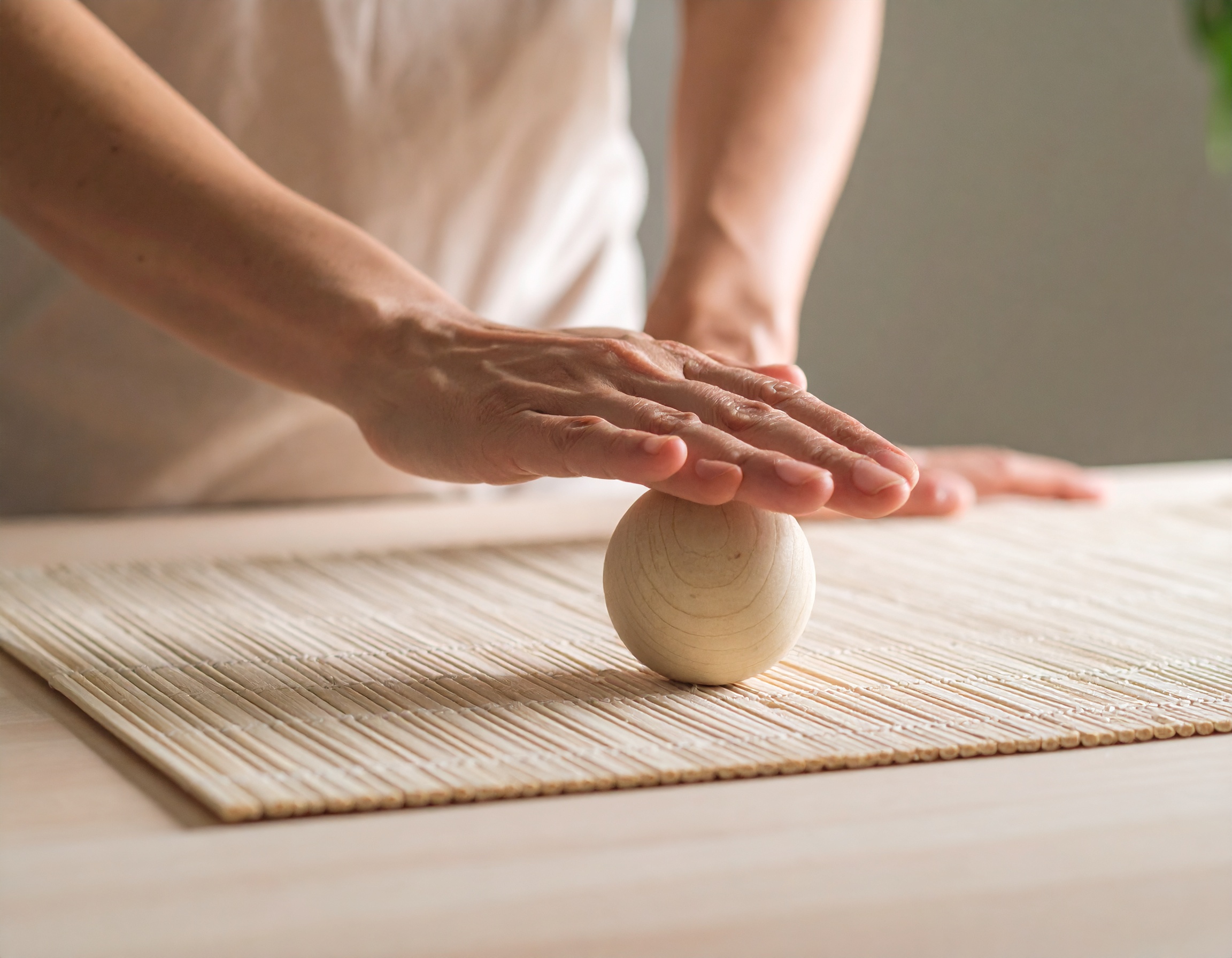
Exercise: press your thumb against a soft ball, but do not try to squeeze it too hard. Hold for 5 seconds and then relax.
Frequency: 2 sets of 5 to 10 reps for each hand, with 1 minute of recovery between each set.
4. Stretching the abductor pollicis brevis
Objective: to relieve muscle tension
Exercise: with your palm turned upwards, gently pull your thumb outwards using your other hand.
Frequency: 5 stretches of 10 seconds each, with 10 seconds of rest between each set. Twice for each hand.
Hold the base of the thumb carefully to avoid any hyperextension of the joint just above (the metacarpophalangeal joint).
These exercises should form part of a daily routine and can be adapted as the pain progresses. We recommend consulting a doctor or healthcare professional in the event of major discomfort.
Improving your day-to-day life with rhizarthrosis
The way in which you use your hand, over and above the exercises you perform, has a direct impact on the pain.
A few simple adjustments can make all the difference:
These tips follow on from the advice provided under ‘Adapting your day-to-day hand movements, tasks and activities’ and ‘Adapting how you perform your work in the event of rhizarthrosis’, which provide details on specific solutions for maintaining your thumb mobility in all contexts.
The more you move your thumb, the more you protect it
Even if it is painful, keeping your thumb moving is still one of the best ways of protecting it.
Physiotherapy and home exercises are about more than just pain relief: they help you maintain a certain independence, regain confidence in your hand movements and slow progression of the condition.
By incorporating a few simple movements into your routine, you can really change the way you live with rhizarthrosis.

